Panzer Dragoon Saga: The Masterpiece SEGA Sabotaged Itself
Released in 1998 on Saturn with only 1,000 copies distributed in Europe, Panzer Dragoon Saga is one of the most acclaimed RPGs in history — 19/20 in the specialist press, impossible to find in stores. Twenty-eight years later, this retrospective review examines a game SEGA undermined before it even had a chance. An editorial scandal and a major work of art.
Topic
Review
Reading
7 min read
Updated
Saturday, August 22, 2026
Key points
- 1Released in 1998 on Saturn with only 1,000 copies distributed in Europe, Panzer Dragoon Saga is one of the most acclaimed RPGs in history — 19/20 in the specialist press, impossible to find in stores.
- 2Twenty-eight years later, this retrospective review examines a game SEGA undermined before it even had a chance.
- 3An editorial scandal and a major work of art.
Lumnix angle
We isolate the useful facts first, then keep the analysis focused on what changes for players.
| Platform | Saturn |
|---|---|
| Genre | RPG, Action-RPG |
1,000 Copies: SEGA Against Its Own Game
Let's start with the defining fact: when Panzer Dragoon Saga arrives in Europe in 1998, SEGA ships only 1,000 units across the entire territory. Not 10,000. Not 5,000. One thousand. For context, an independent PC game with no marketing budget today can move that many units in hours on a digital distribution platform. In 1998, for an ambitious RPG on a console in its death throes, that's a death sentence dressed up as a commercial release.
The Saturn is already in freefall against the PlayStation. SEGA knows the console is finished, that the Dreamcast is coming, and the publisher clearly lacks the will to invest in serious distribution anymore. Panzer Dragoon Saga becomes collateral damage in a strategic withdrawal. The problem is, the game itself is no half-measure.
This retrospective review doesn't seek to canonize a relic out of nostalgia. It's about evaluating what Panzer Dragoon Saga actually delivers, why the contemporary press handed it 19/20 scores, and what playing it feels like today, in 2026, via emulation or the rare physical copies that trade for astronomical prices.
A Genre Shift Few RPGs Have Dared
Panzer Dragoon Saga isn't a direct sequel to the first two Panzer Dragoon games — which are rail shooters, precisely. Team Andromeda executes a radical genre conversion: it becomes an RPG, with a combat system that preserves the essence of the series' DNA—the dragon, spatial movement, and lasers—but integrates it into a turn-based mechanic.
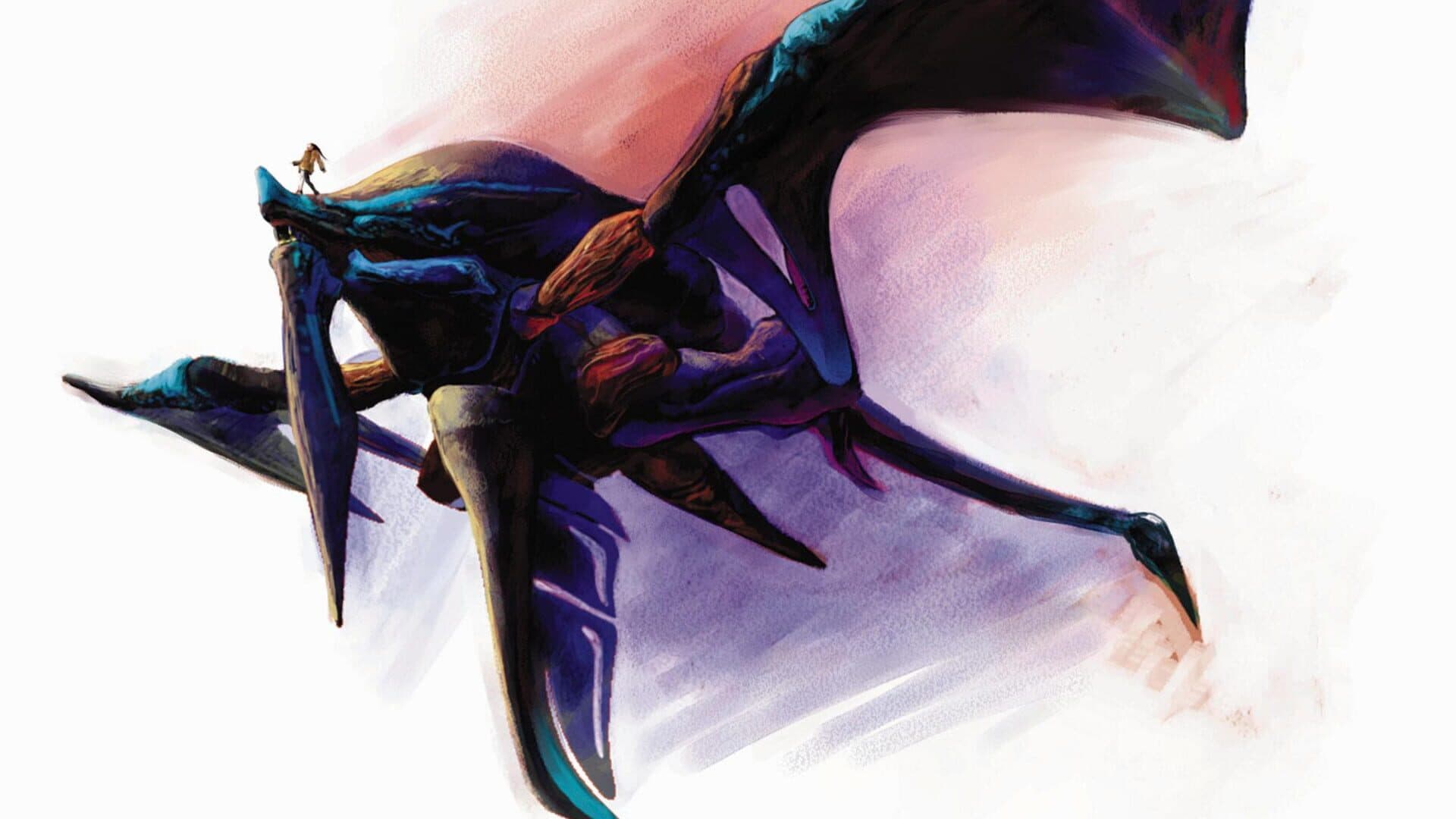
Protagonist Edge finds himself at the heart of an organic post-apocalyptic world, populated by half-mechanical, half-biological creatures, the legacy of an ancient, misunderstood civilization. The Panzer Dragoon universe has always possessed rare visual and thematic coherence: no generic magic, no recycled elves or knights. Team Andromeda's art direction builds something strange and unified, entirely its own.
In 2026, this world hasn't aged in what it conceptually offers. The creature you ride, Edge's relationship with his dragon, the moral ambiguity of the Empire and the Heresies—it all still holds. What has aged is, obviously, the technical presentation.
Combat: A System Between Rail Shooter and Turn-Based RPG
Gameplay hinges on rotational positioning around enemies. In each battle, Edge and his dragon can occupy four quadrants—front, left, right, rear—each offering different defensive or offensive advantages depending on the targeted enemy. Some creatures are vulnerable from behind; others prefer attacking the right flank. You must anticipate, manage a gauge that recharges special attacks and spells, and alternate between Edge's physical attacks and the dragon's lasers.
This system creates tactical tension absent from most RPGs of that era. Where Final Fantasy VII, released a year earlier, offers relatively passive ATB positioning management, Panzer Dragoon Saga demands constant reading of enemy patterns. It's not revolutionary in technical terms—the game remains fundamentally turn-based—but it's distinct enough to avoid feeling derivative.
The dragon evolves alongside Edge: its morphological type changes based on player choices, steering progression toward raw power, magic, or balance. This organic growth mechanic foreshadows what Vagrant Story (Square, 2000) would explore differently in weapon customization. Panzer Dragoon Saga doesn't push this dimension as far as it could, but it adds welcome gameplay ownership.
Narrative: Restrained, Elliptical, Never Condescending
Panzer Dragoon Saga's writing avoids massive exposition dumps. The world is laced with remnants of an ancient civilization, creatures with codified behaviors, factions with partially opaque motivations. Edge isn't a conventional hero—his quest for vengeance ties into something larger quickly, but the game never forces meaning.
Dialogue is sparse, cutscenes restrained for the era. You're far from the verbosity of contemporary JRPGs. This economy of expression isn't weakness: it gives the world mysterious density that drives exploration and interpretation. Players accustomed to modern RPGs that explain every lore mechanic in voice-over might feel disoriented. It's intentional, and it works.
Azel—a central female character, an artificial being whose consciousness awakens—represents one of the genre's most nuanced characterizations on Saturn. Her relationship with Edge avoids the romantic clichés of the time, favoring complicity tinged with existential uncertainty.
Saturn Technical Execution: Between Ambition and Accepted Limits
Let's be honest: Panzer Dragoon Saga shows its 28 years visually. The Saturn, architecturally complex to program, delivers rudimentary 3D polygon environments, low-resolution textures, and sometimes very short draw distances in open terrain zones.
Yet art direction abundantly compensates for these limitations. Organic ruin zones, biomechanic creature designs, the dark ochre color palette—it all creates visual identity many technically superior games never achieved. Team Andromeda works within Saturn constraints rather than against them, opting for condensed environments and stylized battlefields.
The soundtrack by Saori Kobayashi and Mariko Nanba remains one of the most striking scores from the 32-bit generation. Ambient, strange, occasionally tribal, it reinforces the world's otherness without artificially underscoring emotion. Listening to it today as a standalone work still resonates.
Playtime and Structure: A Compact RPG, Not Bloated Epic
Panzer Dragoon Saga concludes in 20 to 30 hours depending on exploration level. That's short for a 1998 RPG, when Final Fantasy VII exceeded 40 hours and Xenogears aimed at exhaustion. This compact format is both strength and limitation.
Strength, because pacing never wavers. Each zone has identity; each narrative beat advances something. No filler dungeons, no side quests diluting central stakes. Limitation, because the combat system and dragon progression deserved more generous development space. Some mechanics seem to stop just as they reach maturity.
Side quests exist but remain understated—a hidden village, rare species to unlock. They add texture without forming a true second content layer. Players who love mechanics-dense RPGs might frustrate at Panzer Dragoon Saga's restraint.
What SEGA Squandered—And Why It Still Matters
Limiting European distribution to 1,000 units wasn't logistical error but deliberate disinvestment. SEGA had the means to do better: the Dreamcast wasn't announced until late 1998 in Japan, and Saturn still had legs. Choosing not to properly distribute Panzer Dragoon Saga deliberately deprived an entire market of a game SEGA's own teams spent years building.
The irony: this artificial scarcity transformed the game into myth. Physical copies now trade for 300 to 700 euros depending on condition and region. An active emulation community made the game accessible since the 2000s, but SEGA has never officially re-released Panzer Dragoon Saga—not on virtual console, not on PC, not in compilation form. Remasters of Panzer Dragoon Remake (Forever Entertainment, 2020) and Panzer Dragoon II Zwei Remake (2022) avoided Saga, likely due to rights complexity and lost portions of the original source code, which SEGA apparently no longer possesses.
This editorial void in 2026 remains inexplicable for a company that successfully exploited other Saturn franchises with Virtua Fighter 5 R.E.V.O. or Yakuza collections. Panzer Dragoon Saga deserves a careful re-release. Its absence says something about SEGA's actual priorities regarding its own legacy.
Verdict: A Work That Endures, Betrayed by Its Publisher
Strengths
- + Visual and thematic universe of exceptional coherence, unmatched in Saturn RPGs
- + Original rotational combat system, tactically engaging without heaviness
- + Restrained, elliptical narrative that respects player intelligence
- + Soundtrack by Saori Kobayashi and Mariko Nanba, still remarkable
- + Pacing without dead weight despite contained playtime
Weaknesses
- − Dated Saturn technology, visible clipping and rudimentary textures
- − Dragon progression system underutilized, cut short before full potential
- − Brief playtime that leaves certain mechanics unresolved
- − No official re-release accessible in 2026—playable only via emulation or at prohibitive cost
Panzer Dragoon Saga isn't perfect. It's short, technically limited by its platform, and its progression mechanics deserved more generous development. But it remains one of the rare 1990s RPGs to build an entirely original, coherent, and non-generic universe, with a combat system that's uniquely its own. The 19/20 scores given back then weren't misjudgment: they honored an ambition few studios possessed.
SEGA committed fault by sabotaging European distribution. Twenty-eight years later, failing to re-release this game is a second fault, quieter but equally damaging. Panzer Dragoon Saga exists despite its publisher, not because of it.
In brief
Released in 1998 on Saturn with only 1,000 copies distributed in Europe, Panzer Dragoon Saga is one of the most acclaimed RPGs in history — 19/20 in the specialist press, impossible to find in stores. Twenty-eight years later, this retrospective review examines a game SEGA undermined before it even had a chance. An editorial scandal and a major work of art.
Our verdict
Panzer Dragoon Saga: The Masterpiece SEGA Sabotaged Itself
Saturn