Doom: The Dark Ages — The Medieval Slayer Who Crushes Everything in His Path
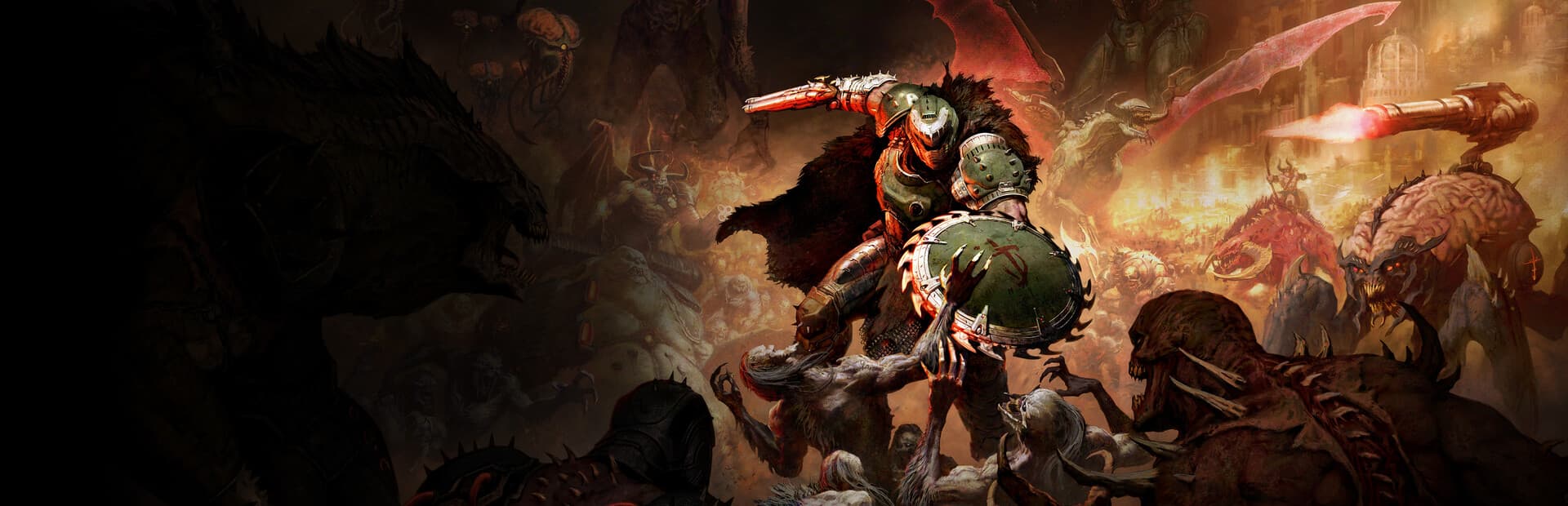
id Software ditches Eternal's vertical frenzy for grounded, unapologetic brutality. Doom: The Dark Ages sets a different pace—heavier, more tactical, yet never losing the saga's DNA. Chainsaw shield, dragons, demonic armor: the Slayer traded his jetpack for gothic plate. Does it work? After twenty-plus hours in the guts of this infernal Medieval age, here's our full verdict.
Topic
Review
Reading
6 min read
Updated
Monday, April 13, 2026
Key points
- 1id Software ditches Eternal's vertical frenzy for grounded, unapologetic brutality.
- 2Doom: The Dark Ages sets a different pace—heavier, more tactical, yet never losing the saga's DNA.
- 3Chainsaw shield, dragons, demonic armor: the Slayer traded his jetpack for gothic plate.
Lumnix angle
We isolate the useful facts first, then keep the analysis focused on what changes for players.
A prequel that dares to question everything
Since Doom 2016 and the creative explosion of Doom Eternal, id Software had established an almost untouchable formula: maximum mobility, vertical arenas, resource management under constant pressure. The Dark Ages throws much of that playbook in the trash. It's not a betrayal—it's a deliberate mutation.
Set chronologically before the events of 2016, The Dark Ages tells the origin story of the Slayer within a Night Sentinels civilization in a medieval-fantasy universe steeped in demonology. The Maykrs are present, the Argent Towers dominate the horizon, and the saga's dense lore finally gets the place it deserves. For cosmically-minded Doom fans, it's a real treat.
Narratively, id makes a genuine effort. The cinematics are lengthy, polished, sometimes spectacular. The Slayer speaks more—cryptically, sure—and the political context of the interdimensional conflict is articulated better than ever. Those who just wanted to kill demons without stopping might check out. Everyone else will be rewarded.
The Chainsaw Shield: the weapon that changes everything
The big mechanical innovation is the Shield Saw—a circular shield equipped with retractable blades that can be thrown like a boomerang or used for active parrying. On paper, it sounds gimmicky. In practice, it revolutionizes how combat is structured.
Blocking an attack at the right moment triggers a counterattack that stuns enemies and generates resources. Spinning the shield slices through small groups and returns automatically. The weapon creates an unprecedented defense-attack loop in the series, forcing you to read enemy patterns rather than perpetually running away.
The Slayer is slower, more grounded. Platform jumping still exists but no longer dominates gameplay. This decision divides—Eternal fans might feel constrained—but it strengthens the impression of embodying something immense and devastating rather than a hyperactive acrobat. It's more Berserk's Guts than Spider-Man.
The medieval arsenal: from war axe to thundergun
Firearms are still here—shotgun, plasma rifle, heavy cannon—but they coexist with enhanced melee weapons and unlikely hybrid contraptions. The Flail of Agony is a two-headed flail that generates demonic energy with each strike. The Thundermace combines a medieval hammer with electrical discharge. Each tool has its place in the rotation.
The weapon progression system was simplified compared to Eternal. Fewer mods, fewer customizable options, but more readable upgrades and stronger immediate impact. You lose some build depth, you gain faster learning. For a game clearly aiming at a wider audience, that's smart.
Glory Kill returns in reworked form: contextual executions are now tied to your equipped weapon type, creating different animations depending on circumstance. Visually, it's an absolutely jubilant orgy of medieval violence.
Single-player campaign: structure, length, difficulty
The main campaign spans roughly 18 to 22 hours depending on chosen difficulty and time spent exploring. Levels are wider, more labyrinthine than previous entries. Open areas pop up occasionally—not a true open world, but intermediate hubs that let you catch your breath, find secrets, and interact with the Night Sentinels.
Dragon missions are the game's most polarizing segments. Mounted on a winged creature, the Slayer engages in aerial combat against demonic fleets. Gameplay shifts radically: you manage stamina resources, execute evasive maneuvers, trigger breath attacks. These sequences are visually impressive—the first few times. By the fourth or fifth dragon mission, the formula shows its limits and repetition sets in.
Boss fights more than compensate. You face titanic entities with multi-phase patterns, some of the most spectacular ever seen in an FPS. The mid-campaign boss especially deserves spoiler-free discovery—suffice it to say it redefines the scale of what you'd expect from this game.
Difficulty is well-tuned on Hurt Me Plenty mode. Ultra-Nightmare exists for masochists and introduces permadeath. Burn & Torture mode adds gameplay modifiers that spice up every encounter for series veterans.
Technical: a visual knockout with tradeoffs
On high-end PC, Doom: The Dark Ages is a spectacle. id Tech 8 delivers volumetric lighting of rare density, demon-stone and steel environments breathing perfectly-rendered gothic weight. Particle effects during explosions and executions hit absurd visual levels that demand respect.
Environments vary intelligently: war-ravaged stone fortresses, infested swamps, levitating Maykr cities, volcanic plains. The art direction is cohesive and ambitious, deliberately moving away from Eternal's sci-fi aesthetic toward something darker, more organic.
On console, the picture is mixed. PS5 runs stable at 60 fps in Performance mode, but 30 fps Quality mode shows noticeable drops in packed arenas. Xbox Series X performs better in Quality mode with appreciable stability. Series S sacrifices some lighting effects but remains playable and beautiful.
Mick Gordon's soundtrack is absent—the composer and Bethesda never publicly reconciled. His replacement, Andrew Hulshult, delivers competent and brutal industrial metal that fills the role. It doesn't reach Doom 2016's heights, but it matches the game's new, heavier tempo.
Multiplayer: honest offering without flash
The Dark Ages offers online multiplayer featuring classic deathmatch, a revisited Invasion mode, and a new Siege mode where two four-player teams battle in a medieval arena with rotating objectives. Siege is the only truly original mode—tight 8-minute matches create constant tension, and the point-capture mechanic with neutral monster spawning recalls certain MOBAs without adopting their complexity.
Deathmatch remains deathmatch. Fast, nervous, uninnovative. Invasion—which in Eternal let you invade another player's campaign—is now optional and better integrated, with fairer balance rules for the defender. It's a welcome addition without being central.
Multiplayer won't be the main reason to buy this game. id Software doesn't pretend otherwise.
What grates, what convinces
A few friction points deserve honest mention. Dragon missions run out of steam too quickly. Some narrative segments slow the pace to the point of breaking flow, especially mid-campaign. The hub map can be confusing and secondary objectives poorly marked.
But what convinces is far more massive. The raw sense of power in combat is unmatched in the genre. The Shield Saw is a simple, brilliant idea that genuinely renews tactical approach. The campaign, despite its rough patches, delivers memorable moments that will stick with series fans. And the lore, finally developed with care, makes you want to explore every corner of this universe.
Verdict: the Slayer doesn't weaken, he evolves
Doom: The Dark Ages isn't Doom Eternal 2. It's a game that takes risks, slows the tempo to dig into something else—weightier violence, a richer universe, a shield mechanic that redefines melee combat in an FPS. Not all these risks pay off 100 percent; the dragon missions prove that.
But id Software proves once again they master their formula better than anyone and won't just repeat it. The Dark Ages is an adult Doom, ambitious, sometimes imperfect, often grandiose. For series fans, it's essential. For newcomers, it might be the best narrative entry point of the modern trilogy.
Final score: 8.5/10
In brief
id Software ditches Eternal's vertical frenzy for grounded, unapologetic brutality. Doom: The Dark Ages sets a different pace—heavier, more tactical, yet never losing the saga's DNA. Chainsaw shield, dragons, demonic armor: the Slayer traded his jetpack for gothic plate. Does it work? After twenty-plus hours in the guts of this infernal Medieval age, here's our full verdict.
Our verdict
Doom: The Dark Ages — The Medieval Slayer Who Crushes Everything in His Path
PC, PS5, Xbox Series X/S