Mario Paint at 34: Nintendo's Hybrid That Blurred the Lines
Released in 1992 on Super Nintendo, Mario Paint wasn't really a game. It was a creation software sold with a mouse, at a time when Nintendo was trying to establish itself in homes as an educational tool as much as an entertainment console. Thirty-four years later, this atypical cartridge remains a textbook example of what a manufacturer can risk when it decides to step outside the boundaries of pure video gaming.
Topic
News
Reading
3 min read
Updated
Tuesday, July 14, 2026
Key points
- 1Released in 1992 on Super Nintendo, Mario Paint wasn't really a game.
- 2It was a creation software sold with a mouse, at a time when Nintendo was trying to establish itself in homes as an educational tool as much as an entertainment console.
- 3Thirty-four years later, this atypical cartridge remains a textbook example of what a manufacturer can risk when it decides to step outside the boundaries of pure video gaming.
Lumnix angle
We isolate the useful facts first, then keep the analysis focused on what changes for players.
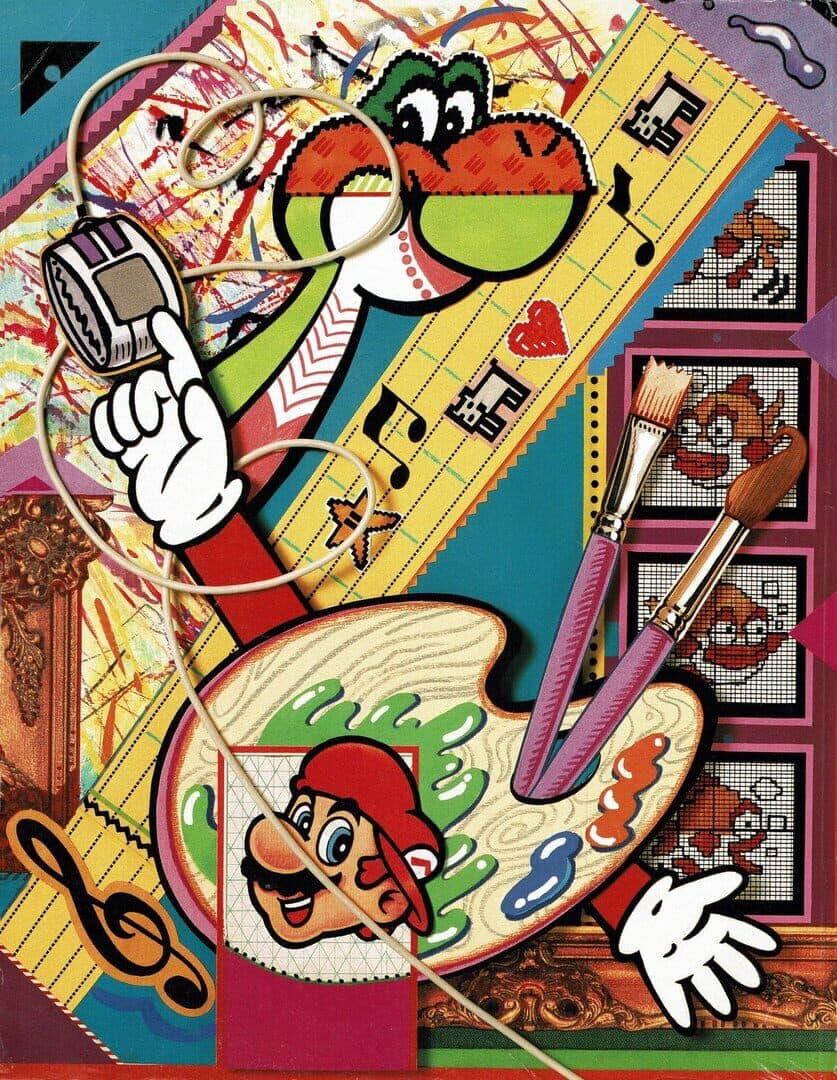
On July 14, 1992, while France paraded down the Champs-Élysées, Nintendo released a Super Famicom cartridge in Japan that defied easy categorization. Mario Paint was neither a platformer, nor an RPG, nor even a game in the strict sense: it was drawing, music composition, and animation software, sold as a bundle with the Super Nintendo Mouse. An anomaly in the manufacturer's commercial strategy, it remains 34 years later a singular object in the history of the medium.
A Software Disguised as a Game, or Vice Versa
The central idea behind Mario Paint was ambitious for its time: to offer children accessible creation tools on a home console, when such functionality had previously been reserved for personal computers like the Amiga or Atari ST. The interface featured a graphics editor with color palette, stamps bearing Nintendo character likenesses, a rudimentary musical sequencer, and a frame-by-frame animation mode.
The positioning was deliberately two-pronged. Nintendo targeted skeptical parents by offering them a productive tool, while maintaining the appeal of the Mario license for children. The commercial maneuver was transparent, but the product itself delivered on its functional promises: the sequencer allowed genuine melodic composition, and the drawing tool offered decent precision for a pointer device on a cathode ray television.
The SNES Mouse: A Risky Bet Never Repeated
What makes Mario Paint structurally important is less the software than the hardware accompanying it. The Super Nintendo Mouse was an unprecedented accessory for a Nintendo console, and its widespread adoption never materialized. Aside from Mario Paint itself and a few PC game ports like Civilization (MicroProse, 1994) or Lemmings (Psygnosis, 1991 on PC, adapted for SNES in 1993), the peripheral never found a large enough software library to take hold.
Nintendo never seriously revived this attempt. The Wii did introduce infrared pointing with Wii Sports (2006) and Warioware: Smooth Moves (2006), but through motion detection logic rather than mouse precision. The Switch integrated touch controls but never reproposed a direct Mario Paint equivalent. The window opened in 1992 never truly reopened in the same form.
An Underground Legacy, Not an Institutional One
Mario Paint's influence didn't travel through official sequels—Nintendo never produced any—but through online communities that rediscovered the musical sequencer in the 2000s. Thousands of renditions of video game themes and popular music were created using the cartridge's audio tool, notably through emulator captures shared on YouTube starting in 2006-2007. This phenomenon preceded and partially fueled the chiptune wave and tools like Mario Maker (Nintendo, 2015), which revived the idea of accessible creation within the Mario universe without ever explicitly claiming that lineage.
The animation mode remains underexploited. At a time when tools like Flipnote Studio (Nintendo, 2008 on DSi) allowed millions of players to create short animations, Mario Paint stands as a quiet precursor, never directly celebrated by its own creator.
34 Years Later: Nintendo and Creation, a Still-Ambiguous Relationship
What the Mario Paint anniversary reveals is a persistent tension in Nintendo's strategy: the manufacturer has regularly opened creation spaces—Mario Maker, Game Builder Garage (2021), Flipnote Studio—without ever building a coherent ecosystem that connects these tools or integrates them into a sustainable offering. Each attempt remains isolated, often orphaned by the next generation.
Mario Paint at 34 is not a nostalgic relic. It's the original document of an ambition Nintendo has never fully embraced or completely abandoned. The fact that no Switch equivalent exists in 2026, when the hybrid console would be perfectly suited for this type of creative software, speaks volumes about the manufacturer's current priorities.
In brief
Released in 1992 on Super Nintendo, Mario Paint wasn't really a game. It was a creation software sold with a mouse, at a time when Nintendo was trying to establish itself in homes as an educational tool as much as an entertainment console. Thirty-four years later, this atypical cartridge remains a textbook example of what a manufacturer can risk when it decides to step outside the boundaries of pure video gaming.