Avowed: Obsidian Entertainment Delivers Its Best RPG in Years
The studio behind Fallout: New Vegas comes back swinging with a dense, well-written, and visually stunning first-person RPG.
Topic
Review
Reading
10 min read
Updated
Thursday, March 19, 2026
Key points
- 1The studio behind Fallout: New Vegas comes back swinging with a dense, well-written, and visually stunning first-person RPG.
- 2Carrying that legacy is as much a curse as a blessing.
- 3With Avowed , Obsidian isn't trying to please everyone — and that's exactly why it works.
Lumnix angle
We isolate the useful facts first, then keep the analysis focused on what changes for players.
| Platform | PC, Xbox Series X |
|---|---|
| Genre | RPG / Action |
| Publisher | Xbox Game Studios / Obsidian Entertainment |
| Release Date | February 18, 2025 |
| Availability | Game Pass (Day One) |
| Lumnix Score | 8.5/10 |
A Heavy Legacy, A Promise Delivered
Obsidian Entertainment is no ordinary studio. Behind that name lies decades of RPGs that defined a whole generation — Fallout: New Vegas, still one of the greatest role-playing games ever made, Pillars of Eternity and its sequel, which pulled the isometric RPG back from the brink, and more recently The Outer Worlds, flawed but sincere. Carrying that legacy is as much a curse as a blessing. Fans expect a masterpiece every time. Critics wait for the first crack. With Avowed, Obsidian isn't trying to please everyone — and that's exactly why it works.
Set in the Pillars of Eternity universe — the Living Lands, a cursed archipelago off the coast of Aedyr — Avowed ditches the isometric perspective and drops the player into a first-person action RPG that draws as much from Skyrim as from Dishonored. That's no accident. The studio clearly studied what made both formulas work, extracted the best of each, and layered its own narrative signature on top. The result is a game that doesn't try to be the biggest open world ever built, but instead fights to be a coherent RPG. In a genre drowning in hollow promises and empty maps cluttered with useless icons, that editorial choice borders on radical.
Let's be blunt: Avowed is Obsidian's best RPG since New Vegas. That's not a throwaway line.
Controls and Gameplay: Freedom as Philosophy
From the first few hours, Avowed sends a clear signal. You're an emissary of the Aedyr Empire sent to the Living Lands to investigate a mysterious plague that turns its victims into hybrid creatures — part human, part plant. That's the setup. But the real question Avowed puts to you early on is: who are you in this world? Your character carries a divine soul — a Godlike — and that distinction shapes every interaction you'll have with local factions, NPCs, and the main storyline.
The combat system is where Avowed surprises the most. On the surface, it looks like a more polished Skyrim. In practice, it's far richer. You can equip a weapon in each hand simultaneously — sword and shield, dual daggers, grimoire and pistol, hammer and magic wand — and swap between two full loadouts mid-fight with a single button press. In practice, you can open an encounter by sniping from a height, switch to melee to chain attacks on a weakened enemy, then pull out a fire grimoire to control the area when reinforcements arrive. That fluidity of transitions turns every fight into a micro-tactical improvisation.
The magic system deserves special mention. It goes well beyond the simplistic spellcasting of The Outer Worlds or the sloppy magic of Skyrim. Grimoires offer directly activated spells as well as persistent area effects that interact with the environment. Freeze the ground to slow a horde, then detonate the ice with a lightning spell. Summon a wind wall to knock arquebusiers off balance on a narrow bridge before charging in. The combinations are varied enough that every player develops their own combat signature, yet readable enough to never tip into unmanageable chaos. That's the difference between depth and gratuitous complexity — Obsidian knows the distinction.
The Living Lands: A World That Refuses to Be a Map
Avowed's open-world design is a bold call at a time when every studio feels obligated to deliver hundreds of hours of diluted content sprawled across a massive map. The Living Lands are an archipelago carved into distinct, dense zones, each with its own visual identity, climate, and political landscape. We're a long way from Starfield's infinite map — and that's excellent news.
Dawnshore opens the game with its misty marshes and fishing villages under colonial influence. Shatterscarp throws you into volcanic plains where the rock is still warm beneath your feet, home to tribes whose beliefs collide head-on with imperial politics. Galawain's Tusks, a spectral forest dedicated to the god of the hunt, is arguably the most visually impressive zone — hundred-meter-tall trees, elven ruins overrun by aggressive wildlife, a near-Lovecraftian atmosphere that cuts sharply against the rest of the game. Every biome plays its own tune.
What sets Avowed apart from generic open-world RPGs is that exploration is rewarded intelligently. No synchronization towers, no icons flooding the screen when you climb a rock. You find documents that mention a specific location, an NPC drops a hint in passing, or you simply notice a strange light at the back of a cave. Secrets are genuinely hidden. I discovered an entire dungeon — with its own narrative arc — because I decided to follow a cliff edge instead of taking the marked path. That kind of moment is priceless in an RPG.
The factions, finally, have genuinely conflicting interests. Helping Aedyr settlers maintain their grip on a region mechanically and narratively weakens the indigenous tribes. There's no solution that satisfies everyone, and the game doesn't pretend otherwise.
Art Direction and Technical Performance: The Devil in the Details
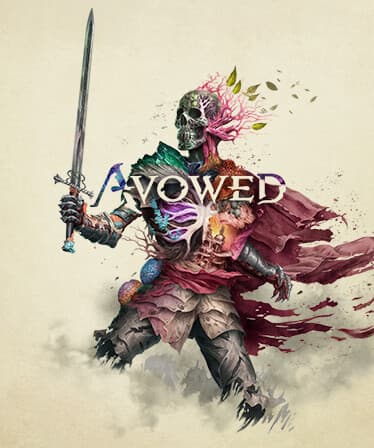
Visually, Avowed is a clear win. The studio opted for a stylized art direction over photorealistic graphics, and it pays off. Colors are saturated without being aggressive; the architecture blends European colonial influences with entirely invented indigenous aesthetics with rare consistency. It occasionally recalls Horizon Forbidden West in the richness of its environmental detail, and at times Dragon Age: Inquisition in the way zones tell their own stories without dialogue.
Facial animations during conversations have clearly been given serious attention. It's not Baldur's Gate 3 — nothing currently is — but it's light-years ahead of the corpse-like stiffness that dragged down The Outer Worlds. Characters look, react, and express. That's enough to keep immersion intact through long conversations.
Technically, the PC version runs smoothly at high resolution on a mid-range rig, load times are short on SSD, and no major bugs surfaced across twenty-plus hours of play — a rarity worth calling out. The Xbox Series X version holds up well, with a stable 60fps performance mode that remains the recommended way to play for combat.
The soundtrack is understated but effective — it knows when to step back and when to step up. It won't be remembered the way New Vegas's is, but it does its job with conviction.
Writing: Where Obsidian Never Compromises
This is the heart of the matter, and it's where Avowed confirms the studio hasn't lost any of its edge. The dialogue is written for real people with real contradictions, not clean archetypes. The colonial governor you meet early in the game is neither hero nor monster — he's a man convinced of the legitimacy of his mission, capable of genuine compassion and systemic violence within the same day. That ambivalence runs through the entire cast.
Kai, your main companion, is a disillusioned former soldier carrying his own moral debts. His relationship with the player is built on disagreement as much as trust — he'll tell you when he thinks you're wrong, and his opinion will shift based on your choices, not the number of times you've talked to him. That's the difference between a written character and an affinity-points system dressed up as a human relationship.
The moral choices, rejecting the genre's usual hero/tyrant binary, genuinely sting at times. At one point I was asked to decide the fate of an entire community knowing that every available option meant an irreparable loss for someone. No magic third path, no miracle diplomacy unlocked by a hidden skill check. Just a hard choice and its consequences, fully owned. That's narrative game design.
Content and Replayability: Quality Over Quantity
Budget 35 to 50 hours for a full first playthrough depending on how thoroughly you explore. This isn't Elden Ring, it isn't The Witcher 3. It's exactly the right length for an RPG that prioritizes density over padding. Every side quest encountered has a reason to exist — it either adds context on a faction, completes a character arc, or unlocks a gameplay system. Generic fetch quests asking you to collect ten plants from a forest are conspicuously, almost entirely absent.
Replayability is real without being artificial. A second run with an opposite character build — full magic versus full stealth, for example — genuinely changes how several major quests resolve and opens up dialogue that's otherwise inaccessible. Certain factions will permanently close their doors depending on your early decisions. This isn't cosmetic.
The day-one availability on Game Pass deserves a mention. For subscribers, Avowed represents one of the best quality-to-accessibility propositions the service has offered since Halo Infinite. For everyone else, full price is justified without reservation.
Strengths
- + The hybrid combat system, fluid and deep, with spellcasting that far outclasses the direct competition
- + The character writing, sharp and honest, with no superficial moralizing
- + Zone density over empty quantity — every corner has something to say
- + Real narrative consequences to player choices that carry through to the ending
- + Cohesive and memorable art direction that gives the world a genuine visual identity
- + Technical stability at launch, a rare achievement in this genre
- + Kai, one of the best-written main companions in Western RPGs in years
Weaknesses
- − Enemy AI lacks ambition — opponents react, but never truly surprise
- − The crafting system remains shallow compared to genre standards — it's easy to ignore entirely
- − Character progression, functional but unremarkable, lacks the skill tree choices that genuinely define a playstyle
- − Some late-game secondary zones show a noticeable drop in narrative density
- − The Pillars of Eternity universe in the background remains largely inaccessible to newcomers — the game doesn't do enough to bring new players up to speed on its own lore
Final Verdict: Obsidian Proves It Still Knows What It Means to Write an RPG
Avowed doesn't try to be the biggest, longest, or most spectacular RPG of its generation. It tries to be the most honest. Honest about what its world can offer, honest about the complexity of its characters, honest about the fact that your choices carry a cost. In a genre where excess has become the norm — infinite maps, hundreds of generated quests, systems stacked on systems to mask the emptiness — that honesty is almost subversive.
Obsidian reconnects here with what made New Vegas great: the idea that an RPG should make you think, not just optimize. That NPCs are people, not quest dispensers. That the world should react to what you do, not simply validate your decisions with a fanfare. The result is imperfect — the progression system lacks bite, combat AI hits its ceiling too fast — but the fundamentals are there, solid and well-handled.
If you're looking for the next Baldur's Gate 3, look elsewhere — the ambitions aren't in the same league. But if you want a narratively demanding action RPG with a consistent vision and genuine gameplay depth, Avowed is probably the strongest case Game Pass has made for itself in a long time. And for a game available at no extra cost with a subscription, that's no small statement.
Lumnix Score: 8.5/10 — A standout RPG, built for players who actually read the dialogue.
In brief
The studio behind Fallout: New Vegas comes back swinging with a dense, well-written, and visually stunning first-person RPG.
Our verdict
Avowed: Obsidian Entertainment Delivers Its Best RPG in Years
PC, Xbox Series X (Game Pass)