DOOM: The Dark Ages — id Software Invents Brutal Medieval
Shield, flail, and demons: id Software reinvents its own mythology in the heart of the Middle Ages. A review on brutality elevated to an art form.
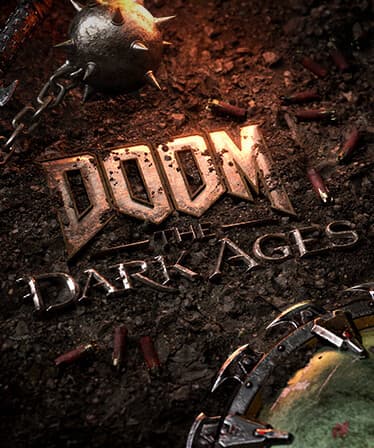
| Platform | PS5, Xbox Series X, PC |
|---|---|
| Genre | FPS / Action |
| Publisher | Bethesda Softworks |
| Developer | id Software |
| Release Date | May 15, 2025 |
| Score | 8.5/10 |
A Deliberate Break, Not a Timid Sequel
Let's be honest from the opening lines: if you're expecting DOOM Eternal with a medieval skin, keep walking. DOOM: The Dark Ages doesn't play that game. id Software had no interest in lazily capitalizing on its predecessor's formula — this studio, since 1993, has always preferred smashing its own foundations rather than resting on them. This new entry is a radical statement of intent: slow the pace, thicken the brutality, plant the Slayer in the dirt rather than in the air.
DOOM Eternal was choreographed death to the millimeter, a ballet where every jump, every chainsaw pull, every dash connected with metronome precision. The Dark Ages is a melee. A cavalry charge where the Slayer plants his feet in scorched earth and advances, inexorable, like a wall of flesh and steel that refuses to bend. This isn't regression—it's mutation. And like any mutation, it disturbs before it convinces.
The narrative context places this episode as a prequel, long before the events of DOOM 2016. We find the Slayer in a visceral dark fantasy universe, trapped between demonic cathedrals and apocalyptic battlefields. The story premise remains what it's always been in the franchise—a ticket to organized violence—but the presentation is polished, coherent, and surprisingly immersive.
Gameplay and Handling: The Shield Changes Everything
This entry's signature weapon isn't a firearm. It's a jagged shield — the Skullcrusher — that you hurl like a boomerang, use to parry projectiles with precise timing, and wield to literally shred enemies at close range. This central mechanic completely reorganizes how you approach confrontations. Less aerial mobility, fewer platforms to chain in desperation, but deliberate ground presence, almost tribal in nature.
The parry system deserves particular attention. Unlike Eternal's forgiving defensive dash, the shield parry demands a tight timing window — not as punishing as Sekiro, but demanding enough that every successful parry delivers immediate physical satisfaction. PS5's haptic feedback amplifies this sensation: blocking a fireball from a Hell Baron and sending it back into his face is one of the raw pleasures this game generously offers.
The firearms arsenal remains substantial. The Super Shotgun returns, as deliciously brutal at close range as ever. The Plasma Mace — new to this entry — introduces a charge mechanic that rewards players who maintain pressure rather than those who retreat. The Rail Cannon offers surgical strikes on heavy targets. But unlike Eternal, where rapid weapon-switching was a permanent mechanical obligation, The Dark Ages lets you find your own rhythm, your own style of carnage. It's less virtuosic, but more personal.
Expect around ten hours to complete the campaign on standard difficulty, more if you hunt through levels for upgrades and collectibles. The game offers four difficulty tiers including an Ultra-Nightmare mode for certified masochists—permanent death included.
Art Direction: Demonic Medieval Finally Coherent
This is probably where The Dark Ages surprises most, and best. id Software faced a perilous mission: create a dark fantasy universe that doesn't reek of cheap cosplay, doesn't feel like poorly-digested Warhammer Fantasy or a first-person Diablo IV. The result exceeds expectations.
The environments are massive, labyrinthine without being confusing, and dense with visual lore. The demonic cathedrals from the first hours—their vaults built from welded bones, their stained glass depicting ritual massacres—set the tone immediately. The art team worked with rare stylistic coherence: every asset, every texture, every decoration tells something without needing a line of dialogue to explain it.
The bestiary has been completely reimagined to match this aesthetic. The Hell Barons wear armor forged from their own flesh—calcified bone plates that have grown around their bodies like natural carapace. Imps now resemble fallen Gothic gargoyles, crouching on ruins before diving at you. Demonic Knights are a new bestiary entry: massive, slow, but capable of absorbing obscene amounts of damage while charging with a brutality that recalls Juggernauts from certain military FPS games, infinitely more menacing.
Technically, the id Tech 8 engine runs at stable 4K/60fps on PS5 and Xbox Series X with no visible compromise. Dynamic ray tracing on demonic armor surfaces during combat is a detail with no functional utility but proves the studio masters its tool. On PC, the game sets an exemplary optimization standard—notable enough to warrant mention.
The Soundtrack: Andrew Hulshult in Gordon's Shadow
Let's address the elephant in the room. Mick Gordon is no longer in charge, and his absence is felt. His collaboration with id Software ended under tense circumstances after DOOM Eternal, and it's Andrew Hulshult — veteran of Prodeus and DUSK — who takes the torch. The verdict is mixed.
Hulshult delivers a brutal, heavy, effective soundtrack. Saturated guitars are there, punchy industrial passages are there, and several tracks hit an intensity that perfectly matches the new combat tempo. The main theme, with its guttural choir and mid-tempo riffs that crush rather than soar, captures the episode's spirit better than any dialogue line.
But let's be honest: DOOM 2016's soundtrack was a sonic revolution. Eternal's, despite chaotic production, contained moments of pure genius — BFG Division remains one of gaming's greatest compositions. Hulshult doesn't operate in that league, and we'd almost blame him for being this good without being exceptional. His work is solid, sometimes very good, never transcendent. For a DOOM game, that's almost criticism.
The sound design outside the music, however, is flawless. The shield whistling through air before erupting against demonic armor, the dull organic sound of Glory Kills reimagined for medieval settings, the deep roars of approaching Titans—every sound is sculpted to maximize the game's physical impact.
Content and Longevity: Dense, Not Infinite
The main campaign spans 22 levels with varied atmosphere: claustrophobic underground dungeons, open battlefields swept by sulfur storms, demonic fortresses perched on solidified lava cliffs. Progression avoids uniformity—developers intelligently alternated open spaces where raw power dominates with tight corridors favoring shield melee combat.
Two gameplay sequences completely break from the usual register. The first puts you at the controls of a demonic dragon for a spectacular on-rails aerial sequence—visually impressive, mechanically limited, but offering welcome pacing relief. The second has you pilot a mechanical Titan dozens of meters tall in battle against a city-scale demonic horde. These sequences recall God of War 2018's gameplay insertions, with less finesse but far more decibels.
Outside the campaign, timed challenge modes return with global leaderboards. Isolated combat arenas to perfect your combos. For completionists, each level hides secret zones unlocking lore archives, permanent upgrades, and cosmetics for the Slayer. Nothing revolutionary in post-campaign content, but substantial enough to justify multiple playthroughs.
Strengths
- + The jagged shield is one of the best new FPS mechanics introduced in years — intuitive, deep, satisfying to master.
- + Art direction is consistent throughout, with a demonic medieval universe that has genuine visual identity.
- + Boss fights reach epic proportions without becoming endurance tests — the confrontation with the demonic Titan mid-campaign, in particular, will rank among this generation's great FPS moments.
- + Gameplay generosity: the game lets you develop your own style without systematically punishing you like Eternal did on higher difficulties.
- + Technical optimization across all platforms is exemplary and uncompromising.
- + Environmental storytelling, subtle but present, gives weight to a universe that could've been treated superficially.
Weaknesses
- − The soundtrack, solid but unmemorable, struggles to reach the iconic status of previous entries. Hulshult does the work—he doesn't forge legend.
- − Reduced mobility will feel like regression to Eternal fans who internalized verticality as fundamental instinct. The transition demands genuine adjustment.
- − Dragon and Titan sequences, spectacular to watch, lack mechanical depth. You'd want more control, more risk.
- − The story remains incidental. Presentation improved, cinematics are polished, but the narrative goes nowhere interesting. For those seeking genuine storytelling, this still isn't where it happens.
- − Post-campaign longevity stays limited for those uninterested in leaderboards or timed challenges.
Verdict: Another Form of Genius
DOOM: The Dark Ages doesn't try to surpass Eternal. It doesn't play on the same field, refuses the same rules, and fully commits to being slower, earthier, more physical. It's a risky bet by id Software—transforming the FPS genre's most agile franchise into something resembling knightly charge more than acrobatic ballet. And that bet, broadly speaking, is delivered.
What elevates this from successful experimentation to something greater is absolute conviction. No hesitation in game design, no wishy-washy compromise trying to please everyone while satisfying no one. The Dark Ages knows exactly what it is and shoves it in your face from the opening seconds. Compared to recent genre reinvention attempts — a Halo Infinite groping in darkness, a Redfall unsure what it wanted to be — this clarity of vision is almost luxury.
The break from Eternal alienates some, just as the break between DOOM 2016 and Eternal already divided back then. That's the mark of a living franchise, in motion, refusing repetition's comfort. The Dark Ages digs in a different direction, and that direction leads somewhere unique, brutal, and memorable. Not the best DOOM. But undeniably a great DOOM.
Our verdict
DOOM: The Dark Ages — id Software Invents Brutal Medieval
PS5, Xbox Series X, PC