Ghouls'n Ghosts Mega Drive: The Arcade Game That Defined a Console
Before Super Ghouls'n Ghosts was designed natively for the Super Nintendo, Ghouls'n Ghosts was an arcade cabinet that the Mega Drive elevated to absolute reference status. This isn't a minor detail—it says something precise about what Sega demanded from its machine and what players of that era actually experienced. Revisiting this port means understanding why certain titles forge a platform's identity better than any exclusive game designed for it.
Topic
News
Reading
3 min read
Updated
Monday, August 3, 2026
Key points
- 1Before Super Ghouls'n Ghosts was designed natively for the Super Nintendo, Ghouls'n Ghosts was an arcade cabinet that the Mega Drive elevated to absolute reference status.
- 2This isn't a minor detail—it says something precise about what Sega demanded from its machine and what players of that era actually experienced.
- 3Revisiting this port means understanding why certain titles forge a platform's identity better than any exclusive game designed for it.
Lumnix angle
We isolate the useful facts first, then keep the analysis focused on what changes for players.
Ghouls'n Ghosts debuted in Capcom arcades in 1988, then ported to Mega Drive the same year in Japan. This genesis detail changes everything about how we must read this game: unlike Super Ghouls'n Ghosts (1992, Super Nintendo), which was designed from the ground up for Nintendo hardware, the Mega Drive version is an adaptation. Yet it was this version that most European players encountered first, often as a launch title or early adopter game.
A Port That Didn't Behave Like a Port
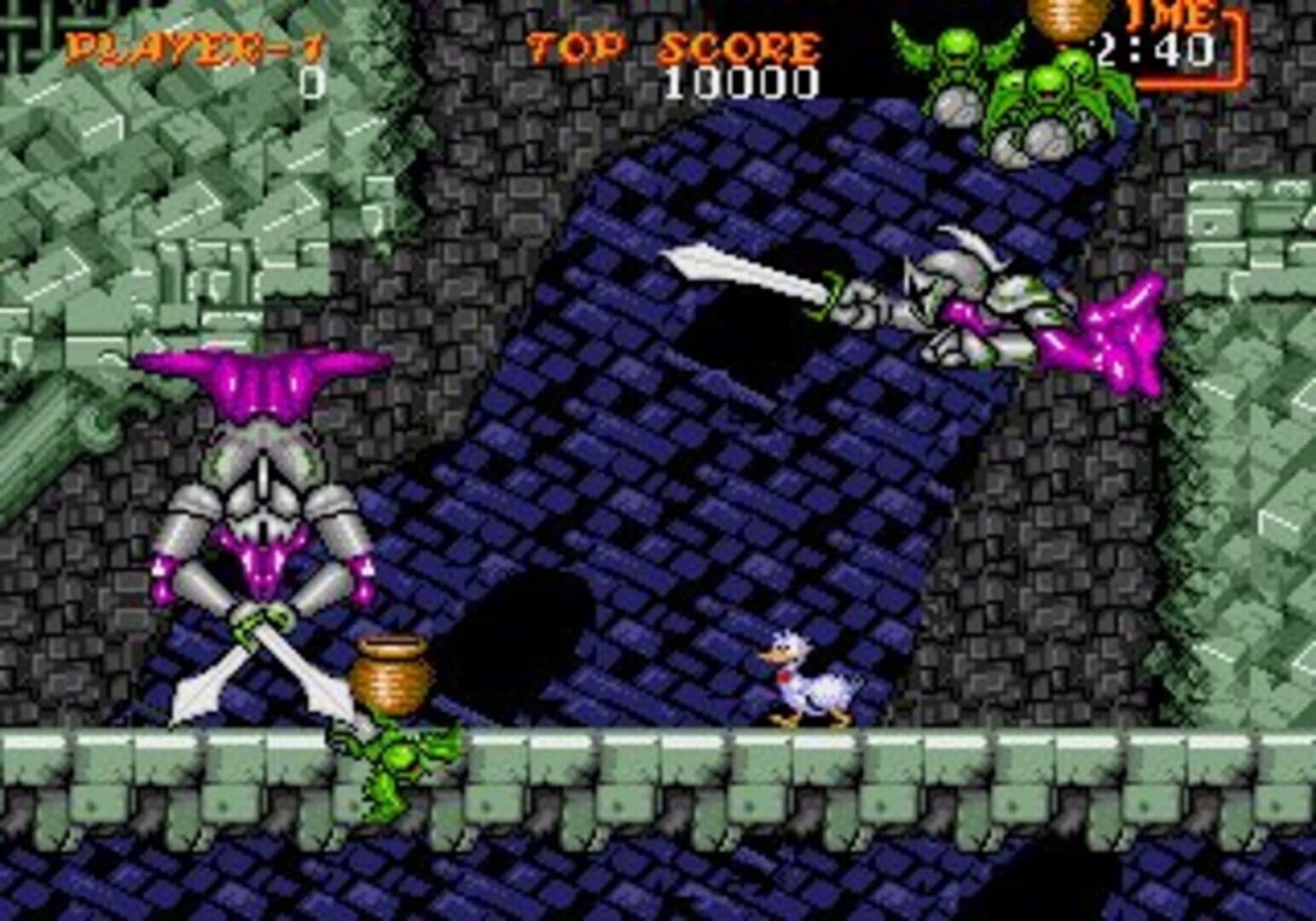
Back then, bringing an arcade game to a home console almost always meant painful compromises. Examples abound: Street Fighter II on SNES in 1992 had to sacrifice animation frames, and Mortal Kombat on Mega Drive in 1992 lost its blood by default. Ghouls'n Ghosts on Mega Drive largely escaped this curse. The fluidity was there, sprite clarity too, and the arcade's brutal difficulty—that armor mechanic that leaves you in your underwear before death—was perfectly preserved.
This wasn't trivial for a machine whose Motorola 68000 CPU clocked at 7.67 MHz had to rival technically superior arcade cabinets. The adaptation work delivered on its promise where many failed.
The Mega Drive Needed This Game As Much As It Needed the Console
In Europe, the Mega Drive was fighting to establish itself against a still-dominant NES and an incoming Super Nintendo. It needed titles capable of striking hard visually and signaling that the console was in another league. Ghouls'n Ghosts filled this role with rare efficiency: parallax scrolling, intelligently used color palette, and a soundtrack that leveraged the Yamaha YM2612 sound chip in ways few games of that period exploited as effectively.
This isn't misplaced nostalgia. It's a technical fact: the game made the machine work, and the machine answered. This alliance between an ambitious port and hardware seeking legitimacy produced something greater than the sum of its parts.
Super Ghouls'n Ghosts Isn't the Sequel—It's a Different Philosophy
Let's be clear because the confusion persists: Super Ghouls'n Ghosts isn't the direct successor designed to surpass the Mega Drive version. It's a game conceived natively for the Super Nintendo, with its own constraints and strengths—Mode 7, an extended palette, reworked gameplay including double jump and a new golden armor. Both games embody two visions of the same character, Arthur, on two competing machines.
Comparing the two as if one were objectively superior misses the point entirely: each speaks to its hardware, and it's precisely this intimate relationship between a game and its machine that makes both memorable. The Mega Drive version remains the encounter between a brutal arcade game and a console that had everything to prove. That's not a defensive position—it's what gives it its singular place in the platform's history.
Thirty-eight years after its arcade debut, Ghouls'n Ghosts on Mega Drive hasn't aged uniformly—the difficulty can seem arbitrary to contemporary players—but it remains a textbook case in intelligent adaptation rather than mere conversion. Few ports from that generation can claim as much.
In brief
Before Super Ghouls'n Ghosts was designed natively for the Super Nintendo, Ghouls'n Ghosts was an arcade cabinet that the Mega Drive elevated to absolute reference status. This isn't a minor detail—it says something precise about what Sega demanded from its machine and what players of that era actually experienced. Revisiting this port means understanding why certain titles forge a platform's identity better than any exclusive game designed for it.