Virtua Racing at 34: The Arcade Game That Launched 3D Gaming
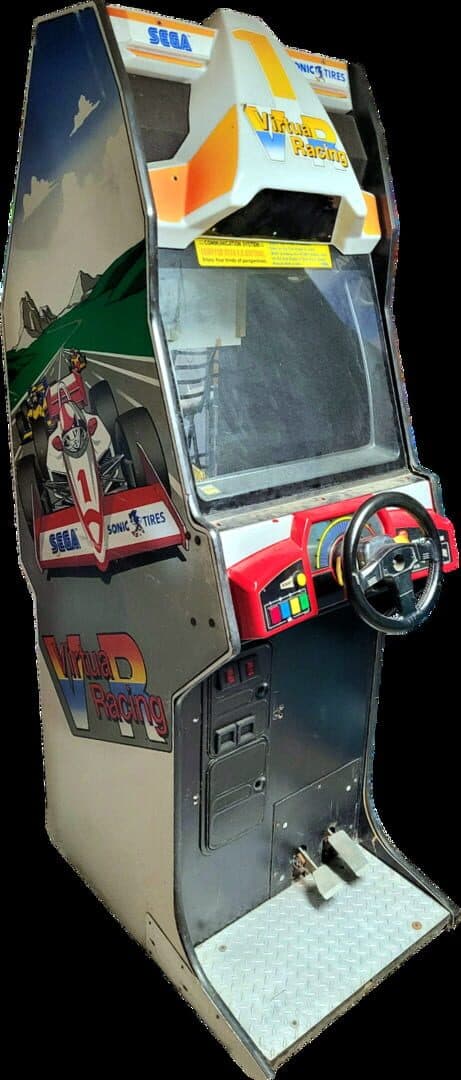
In August 1992, Virtua Racing hit arcade cabinets and laid the foundation for a technological shift the industry had never seen before. Never becoming a franchise, quickly overshadowed by Ridge Racer, Daytona USA, and Sega Rally Championship, the game remains one of the most decisive milestones in 3D gaming history. Why does a title with no sequel and no direct descendants continue to occupy such a special place in racing game lore?
Topic
News
Reading
3 min read
Updated
Monday, August 31, 2026
Key points
- 1In August 1992, Virtua Racing hit arcade cabinets and laid the foundation for a technological shift the industry had never seen before.
- 2Never becoming a franchise, quickly overshadowed by Ridge Racer, Daytona USA, and Sega Rally Championship, the game remains one of the most decisive milestones in 3D gaming history.
- 3Why does a title with no sequel and no direct descendants continue to occupy such a special place in racing game lore?
Lumnix angle
We isolate the useful facts first, then keep the analysis focused on what changes for players.
August 1992. Sega slides a flat-polygon racing game into arcade cabinets that looks like nothing players have ever seen. Virtua Racing isn't the first 3D game in history, but it's the first to make the thing playable, smooth, immediate. Thirty-four years later, the title has no sequel, no reboot announced, yet it keeps surfacing in discussions about the origins of modern gaming. This isn't nostalgia: it's recognition of a turning point.
A Graphics Engine That Made the Competition Obsolete Before It Even Existed
In 1992, Sega's Model 1 arcade board packed hardware designed specifically to process polygons in real-time at speeds domestic machines wouldn't approach for years. Virtua Racing ran at 60 frames per second on this architecture, with three circuits, five different camera angles, and precise handling. This wasn't a technical showcase dressed up as a game: it was a complete game, built around a clear gameplay proposition.
What made the achievement even sharper was the context. In 1992, dominant racing games relied on scaled sprites or pseudo-3D techniques—the Super Nintendo's Mode 7 engine, used notably in F-Zero (Nintendo, 1990), gave a convincing illusion but remained fundamentally flat. Virtua Racing shattered that ceiling without warning.
Quickly Surpassed, But Never Replaced in Its Role
Virtua Racing's commercial lifespan was short. By 1993, Ridge Racer (Namco) arrived in arcades with textures on its polygons, making Virtua Racing's bare polygons immediately look dated. In 1994, Daytona USA (Sega AM2) and Sega Rally Championship (Sega AM3, 1995) drove the nail home: textured 3D racing became the standard, and Virtua Racing already looked like ancient history.
But that rapid obsolescence says something important: Virtua Racing opened a door that others walked through instead. It didn't build a franchise because it didn't need to—its mission was existence, not commercial longevity. Sega itself channeled the project's energy toward other series, notably Virtua Fighter (1993) on the same Model 1 architecture, which survived and spawned multiple sequels.
This is a recurring tension in Sega's history. The Japanese company has a well-documented habit of laying major technological foundations without necessarily reaping the long-term benefits. The Model 1 running Virtua Racing produced an arcade catalog among the most impressive of the 1990s, but Sega never turned Virtua Racing into a sustainable license the way its direct competitors did.
Ridge Racer is now at its seventh mainline entry. Daytona USA saw several arcade and console iterations. Virtua Racing stopped at a few ports—including a 1994 Mega Drive version using the SVP chip, already a technical achievement in its own right—and a reissue on the Sega Ages compilation in 2018 on Nintendo Switch. That's it.
This restraint doesn't erase the impact. It might make it sharper: Virtua Racing doesn't need a franchise to exist in history. It's cited, studied, mentioned precisely because it wasn't diluted.
34 Years Later, It's Not About Nostalgia—It's About Debt
Looking back at Virtua Racing in 2026 isn't mourning a lost era. It's acknowledging that a significant part of what modern racing games take for granted—the dynamic camera, the readability of a 3D circuit, the sensation of speed in real three-dimensional space—was laid down there, in August 1992, in Japanese arcade halls, by a Sega AM2 team led by Yu Suzuki.
No sequel will probably come to correct this commercial invisibility. But the absence of a sequel isn't a failure: it's the mark of a title whose role was to change the rules, not exploit them.
In brief
In August 1992, Virtua Racing hit arcade cabinets and laid the foundation for a technological shift the industry had never seen before. Never becoming a franchise, quickly overshadowed by Ridge Racer, Daytona USA, and Sega Rally Championship, the game remains one of the most decisive milestones in 3D gaming history. Why does a title with no sequel and no direct descendants continue to occupy such a special place in racing game lore?